
Last Updated on November 19, 2026 by Zahid Zubair
BISP has changed how it pays. Your quarterly payment no longer has to be collected in cash from a campsite. It now goes into a digital wallet through BISP Benazir SIM wallet registration, and that wallet is linked to a free Benazir SIM issued in your name. If your wallet is not registered and activated, your payment can stop — even if you are eligible.
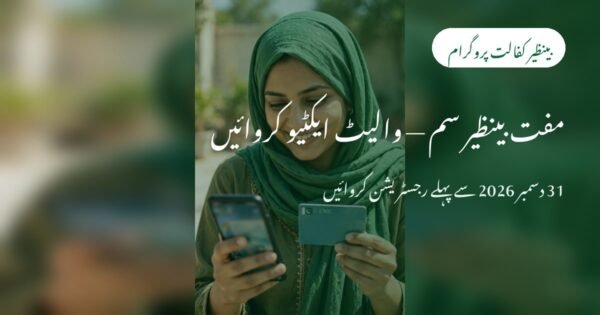
This guide explains, in plain words, what the Benazir SIM wallet is, how to get your free SIM, how the wallet is activated, what the 31 December 2026 date really means, and what it costs to withdraw your money. Everything here is checked against BISP’s own press releases, the State Bank of Pakistan briefing reported in the national press, and the official 8171 portal.
Quick facts: Programme — Benazir Kafaalat (BISP). Current payment — Rs. 14,500 per quarter, October–December 2026. The SIM — Free Benazir SIM, from a BISP office only. Wallet activation — Free. Cash withdrawal fee — Rs. 280 per cash withdrawal (verified). Online / RAAST transfers — Free. Digitalisation target date — 31 December 2026 (SBP briefing to the National Assembly committee, 10 July 2026). Check your status — 8171.bisp.gov.pk, or SMS your CNIC to 8171. Helpline — 0800-26477 (free).
What is the Benazir SIM wallet?
The Benazir SIM wallet is a digital account that holds your BISP payment. It is opened against your CNIC and linked to a free mobile SIM — the Benazir SIM — that BISP gives you. The SIM is not an ordinary shop SIM. It is issued by BISP, it is registered in your name, and your wallet is connected to it.
Here is how it works in practice. When your quarterly payment is released, the money goes into your wallet instead of being handed to you in cash at a campsite. You get an SMS from 8171 when the money arrives. You can then withdraw it in cash from any authorised retailer of a partner bank, in any city, with your original CNIC and a fingerprint check. You do not have to withdraw it at once — BISP has said the money stays safe in the wallet and you can collect it at your convenience.
Six partner banks run this system together: HBL, Habib Microfinance Bank, Bank Alfalah, Bank of Punjab, Telenor Microfinance Bank (Easypaisa), and Mobilink Microfinance Bank (JazzCash). Because the wallets work across all six banks, you are not tied to one bank or one city. If you travel to another city, you can still withdraw from an authorised retailer there.

BISP started moving payments to wallets in July 2026. By August 2026, the BISP Chairperson said wallet accounts had already been opened for 90 per cent of women beneficiaries. The first payment under the new six-bank system began on the evening of 12 November 2026, released phase by phase, district by district. At a briefing on 29 October 2026, it was reported that 9.7 million Benazir SIMs had been activated.
The 31 December 2026 date — what it really is
You will see 31 December 2026 quoted on many websites as the wallet registration deadline. Here is what that date actually is, and what it is not.
On 10 July 2026, the Deputy Governor of the State Bank of Pakistan told the National Assembly’s Standing Committee on Poverty Alleviation and Social Safety that the complete digitalisation and mandatory online functionality of BISP beneficiary accounts was scheduled for 31 December 2026. The News reported the briefing the same day. That is the source of the date: it is the target for finishing the move of all BISP accounts onto the digital system.
What BISP has not done is publish a separate notice saying “wallet registration closes on 31 December 2026”. The date is real, and it comes from the State Bank’s briefing to Parliament — but it is a digitalisation target, and other websites describe it as the registration deadline because the two things amount to the same practical warning: after the system is fully digital, payments go through wallets, and a woman without an activated wallet may not receive her payment.
There is one more reason not to trust forwarded dates blindly. Some websites earlier quoted 30 September 2026 as the deadline for collecting the free SIM. That date passed, and SIM issuance continued afterwards as a final chance. Dates in this programme have moved before. Missing 31 December 2026 does not cancel your eligibility — it is the State Bank’s digitalisation target, not a BISP-issued cutoff. Still, get your free SIM early: offices are crowded in the last week of December, and a delay can disrupt your payment.
BISP Benazir SIM wallet registration — how to get your free SIM and activate your wallet
There is no online form for this. No website and no agent can register your wallet from home. The whole process happens in person, at a BISP office, and it is free.
Step 1: Check your status first. Before you travel, send your 13-digit CNIC number by SMS to 8171, or check it on the official portal at 8171.bisp.gov.pk. The reply tells you whether your record is active. If it says a survey is required, or you are not eligible, sort that out first at a BISP Tehsil Office — a wallet cannot receive a payment for a record that is not active. You can also check your payment status on our BISP 14500 payment status guide.

Step 2: Go to your nearest BISP office. Take two things with you: your original CNIC (not a photocopy) and your own mobile phone. The SIM will be put into your phone there. If you are not yet registered with BISP at all, you will first need the free NSER Dynamic Survey at the Tehsil Office — see our BISP new registration guide for the documents and steps.
Step 3: Let the staff insert the SIM and activate the wallet. A representative of the mobile network operator will put the Benazir SIM into your phone and activate your wallet on the spot. The wallet cannot be used until this activation is done. The SIM and the activation are completely free — do not pay anyone for them.
Step 4: Complete the fingerprint check. You will be asked to place your finger on a scanner. This confirms that you are the registered beneficiary. It cannot be skipped, and nobody can do it for you.
Step 5: Write down your new number and keep it safe. Note the new mobile number at home, somewhere you will not lose it. This is now the number BISP will use for your payment messages. Keep the SIM in your phone and keep it active — a switched-off or lost SIM is the most common reason a wallet stops working.
Step 6: Wait for the 8171 SMS. When your quarterly payment is released, you will get an SMS from 8171. Only then should you go to withdraw it. Do not travel on the basis of a message from any other number.
The six partner banks — and what “any city” means
The six banks in the wallet system are HBL, Habib Microfinance Bank, Bank Alfalah, Bank of Punjab, Telenor Microfinance Bank (Easypaisa), and Mobilink Microfinance Bank (JazzCash). BISP announced their interoperability on 20 October 2026, which means a wallet opened through one bank can be used at the authorised retailers of the others.
In practice this means two things. First, you are not restricted to the bank or the district that issued your payment. Second, you can withdraw from an authorised retailer in any city, at any time, once the money is in your wallet. What does not change is the identity check: you must go yourself, with your original CNIC, and complete the fingerprint verification. No one can collect your payment for you, and no retailer can pay you without that check.

Withdrawing your money — and the Rs. 280 fee
This is the part most people get wrong, so here it is plainly. Taking cash out of your wallet costs a fixed service charge of Rs. 280 per cash withdrawal. This is confirmed by BISP itself: in Press Release No. 54, issued in Swat on 11 July 2026, the BISP Chairperson said, “Digital Wallet activation is free, while the cash withdrawal service fee is PKR 280.” The same figure was given by the State Bank of Pakistan in its briefing to the National Assembly committee on 10 July 2026.
Three things follow from that. First, the Rs. 280 applies only when you take cash out. Online transfers and RAAST transfers from the wallet are free. Second, the SIM, the wallet activation and the registration cost nothing — the only fixed charge in the whole system is the Rs. 280 on a cash withdrawal. Third, the State Bank reviews the schedule of charges every six months, so the figure can change — always check the amount shown by your authorised retailer before you approve a withdrawal.
The Rs. 280 is a service charge, not a deduction. A deduction is an unlawful cut taken by an agent. If an agent takes more than Rs. 280 from a cash withdrawal, or asks you for any other payment, that extra money is not part of the official charge. Count your cash on the spot, take a receipt if one is offered, and report the agent on the helpline 0800-26477 or at your Tehsil Office. Our full-payment and complaint guide explains the complaint steps in detail.
One more practical point: your money stays safe in the wallet, so there is no need to withdraw it the day it arrives. BISP has said the funds remain secure in the wallet and can be withdrawn at any time. If the payment point is crowded, wait a day or two and go when it is quiet.
What happens if you miss the date?
BISP has said that upcoming instalments will be paid only through digital wallets, and that beneficiaries without a Benazir SIM will not receive their payments. That is the consequence to take seriously. What no official source has said is that campsite cash collection ends on a particular date — so this guide does not claim that. What is certain is the direction of travel: the system is becoming wallet-only, and the 31 December 2026 digitalisation target is the date the State Bank gave Parliament for completing that move.
If you missed an earlier date, do not assume it is too late. The 30 September 2026 SIM collection date passed and issuance continued. Go to your nearest BISP office now with your original CNIC and your own phone, and ask for the free SIM and wallet activation. The sooner the wallet is active, the sooner your next quarterly payment can reach it. The current quarter is Rs. 14,500 for October to December 2026. The Rs. 18,000 figure you may hear about for January 2027 is only a proposal announced in the federal budget — it has not been confirmed as a paid amount, so do not plan around it.
Common problems and how to fix them
The SIM is in someone else’s name. This is the most common reason a wallet fails. The wallet can only open on a SIM registered in the woman’s own name, on her own CNIC. A SIM in your husband’s or a relative’s name will not work, and your payment can be blocked. Go to the BISP office and get the official Benazir SIM issued in your own name. Do not buy a SIM from a shop and expect it to receive payments — only a SIM from a BISP office works.

The SIM is lost or stolen. Go to your nearest BISP office with your original CNIC and report it. Do not buy a replacement SIM from a shop or pay an agent to “restore” your wallet. The replacement and reactivation happen through the BISP office, and they are free.
The fingerprint does not match. Wash and dry your hands, and try again. Try another finger. If your fingerprints are worn — common after years of manual work — and no finger reads, go to NADRA to update your fingerprint record. If your prints cannot be read at all, NADRA can issue a facial verification certificate, which BISP accepts.
The payment is not in the wallet. First check your status by SMS to 8171 or on the official portal. Remember that payments are released phase by phase, district by district, so your neighbour may be paid before you. If your status says eligible but no money has arrived, check that your wallet is activated and your SIM is in your own name. If both are in order and the money still has not come, visit your Tehsil Office with your CNIC.
You never received the 8171 SMS. Check that the SIM in your phone is the official Benazir SIM and that it is active. Messages from any number other than 8171 are not from BISP.
How we checked this guide
This guide was written by the 8171ehsaasportal.pk team, which covers the Benazir Income Support Programme and the Ehsaas Kafalat Programme for readers across Pakistan. Every fact in it was checked against an official source before publication: BISP Press Release No. 54 (11 July 2026) for the free activation and the Rs. 280 cash withdrawal fee; the State Bank of Pakistan briefing to the National Assembly Standing Committee on 10 July 2026, as reported by The News, for the 31 December 2026 digitalisation date and the same fee; BISP’s press releases on SIM collection for the in-person process; and the official 8171 portal for status checks. Where a date or figure could not be confirmed from an official source, this guide says so instead of presenting it as fact. The guide was last verified on 15 November 2026, and it will be updated if BISP changes the rules.
FAQs
Q1: Do I need the Benazir SIM to receive my BISP payment?
Yes. BISP now pays through digital wallets linked to a free Benazir SIM. BISP has said that beneficiaries without a Benazir SIM will not receive their payments. The SIM is free, and it is collected only from a BISP office with your original CNIC.
Q2: Is the SIM and wallet activation really free?
Yes. Both are completely free. BISP’s own press release says wallet activation is free, and the only fixed charge in the system is Rs. 280 on a cash withdrawal. Anyone who asks you to pay for the SIM, the activation or the registration is running a scam.

Q3: What is the Rs. 280 charge?
It is a fixed service charge for taking cash out of your wallet, confirmed by BISP (Press Release No. 54, 11 July 2026) and by the State Bank of Pakistan. It applies only to cash withdrawals. Online transfers and RAAST transfers from the wallet are free. It is not a deduction, and no agent may take more than this.
Q4: My SIM is in my husband’s name. Will my payment still come?
No — a wallet cannot open on a SIM that is not in your own name, and your payment can be blocked. Go to your nearest BISP office with your original CNIC and get the official Benazir SIM issued in your own name as soon as you can, so your payment is not delayed.
Q5: I lost my SIM, or my fingerprint does not match. What should I do?
For a lost SIM, go to your nearest BISP office with your original CNIC — the replacement is free, and never buy one from a shop. For a fingerprint that will not read, wash and dry your hands and try another finger; if it still fails, update your fingerprints at NADRA, or get a NADRA facial verification certificate if your prints cannot be read at all.
A note for readers: 8171ehsaasportal.pk is an independent information website. It is not the official website of BISP, the Ehsaas Programme, or the Government of Pakistan, and it is not affiliated with any of them. This guide cannot check your payment or eligibility — only BISP can do that, through the official portal at 8171.bisp.gov.pk, by SMS to 8171, or at a BISP Tehsil Office. If you spot a mistake in this guide, please tell us through our Contact Us page.
Last checked: 19 November 2026.
Related guides: